3 min readCareersPortfolioInternships
How to Build a Portfolio Recruiters Actually Open
Grades and certificates get you shortlisted. A small, well-explained portfolio is what gets you remembered. Here is how to build one, whatever your stream.
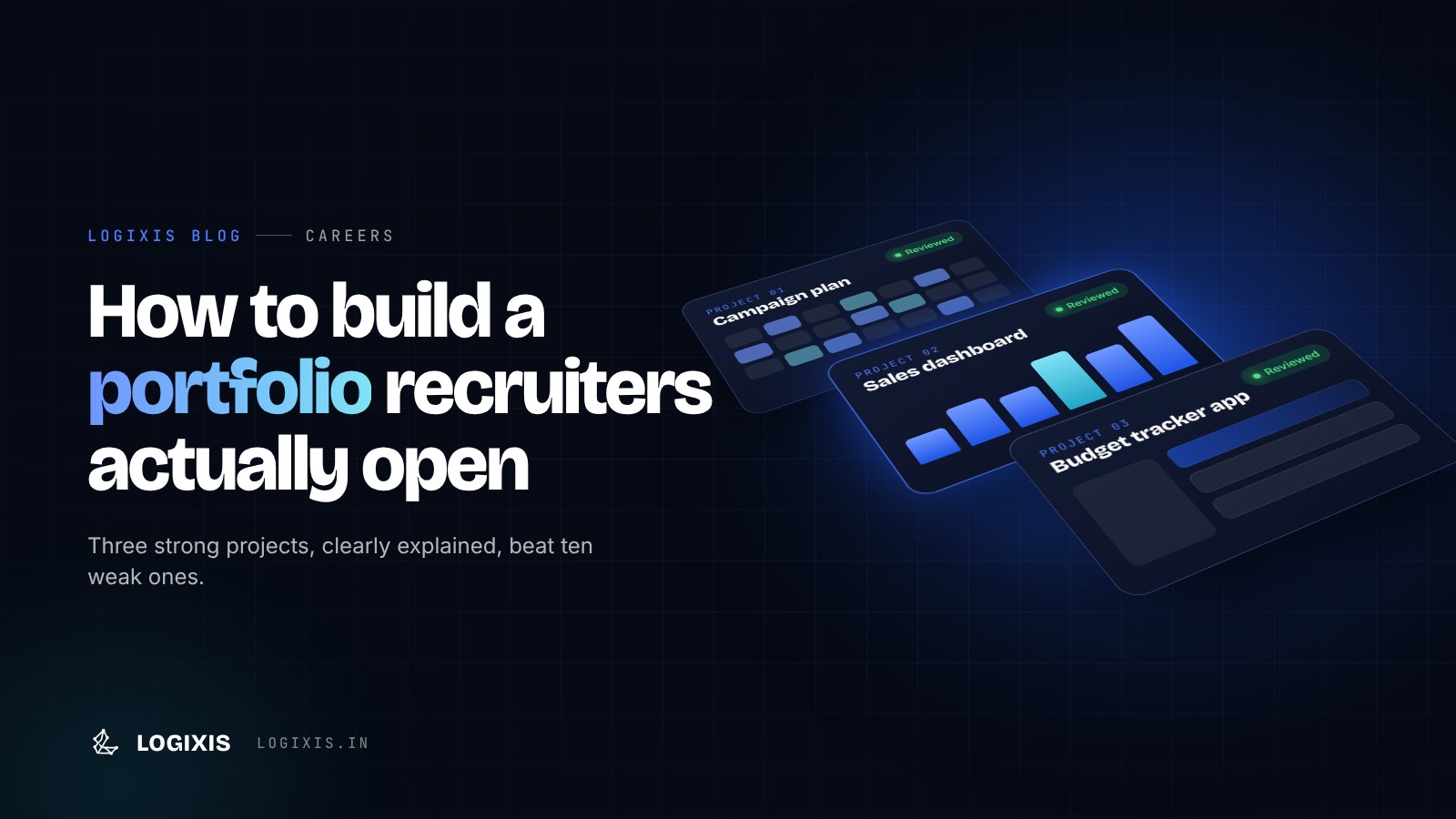
Most students treat a portfolio as something only designers and developers need. That is a mistake. Whether you study engineering, commerce, management or arts, a recruiter is trying to answer one question: can this person actually do the work?
A degree says you attended. A certificate says you finished a course. A portfolio shows what you can do. Here is how to build one that people open, read and remember.
1. Pick projects that look like real work
Recruiters skim. A project called "Assignment 3" tells them nothing. A project called "Sales dashboard for a retail chain" tells them what you built and why it matters.
Choose projects that mirror tasks in the role you want:
- Data or analytics roles: a dashboard or analysis built on a real public dataset
- Software roles: a working app someone can open and use
- Marketing roles: a campaign plan or content calendar with clear goals
- Finance roles: a valuation or financial model with your assumptions written out
- Product roles: a teardown of an app you use, with problems you found and fixes you would ship
Three strong projects beat ten weak ones.
2. Explain the problem before the solution
Every project should open with two or three lines that answer:
- What problem were you solving?
- Who was it for?
- What did you end up with?
This is the part most portfolios skip, and it is the part recruiters read first. If they understand the problem in ten seconds, they will look at the rest.
3. Show your thinking, not just the result
A finished dashboard is good. A finished dashboard with a short note on why you chose those charts, what you left out and what you would do with more time is much better.
Write a few lines on:
- The decisions you made and why
- One thing that went wrong and how you fixed it
- What you would improve next
This is what interviews are about anyway. Your portfolio lets you start that conversation before you are in the room.
4. Make it easy to check
Anything a recruiter cannot open, they will not trust. For each project, include at least one of these:
- A live link they can click
- Screenshots of the key screens or outputs
- The file or code, shared with view access
Test every link in a private browser window before you send it. A broken link quietly ends a lot of applications.
5. Keep it to one page they can scan
Your portfolio does not need to be a website. A single clean page works if it has:
- Your name, the role you are aiming for and how to reach you
- Three to five projects, each with a title, a two-line summary and a link
- One line on the tools you used for each
Put your strongest, most relevant project first. Most people will not scroll far.
6. Get feedback before you share it
You cannot judge your own work fairly. Before you send your portfolio anywhere, ask someone to look at it for two minutes and tell you:
- What they think you are good at
- Which project they remember
- Anything that confused them
If their answers do not match what you wanted them to see, fix that first.
7. Put it everywhere you apply
A portfolio only helps if people see it. Add the link to:
- Your CV, near the top
- Your LinkedIn profile, in the featured section
- Every application form that has a "website" or "links" field
- Your email signature when you reach out to recruiters
Start with one project this week
You do not need a perfect portfolio to start. Pick one project, write the problem, show your thinking and share a link. Then build the next one.
If you want a structured way to do this, every LOGIXIS course ends in a project that a reviewer scores and gives feedback on, and finishing it earns a certificate recruiters can verify online. Browse the courses and pick one that matches the role you want.
Learn it. Build it. Prove it.
Pick a course, build a reviewed project and earn a certificate recruiters can verify.
Browse courses